

Why Are We Drawn to Moonlit Paintings?
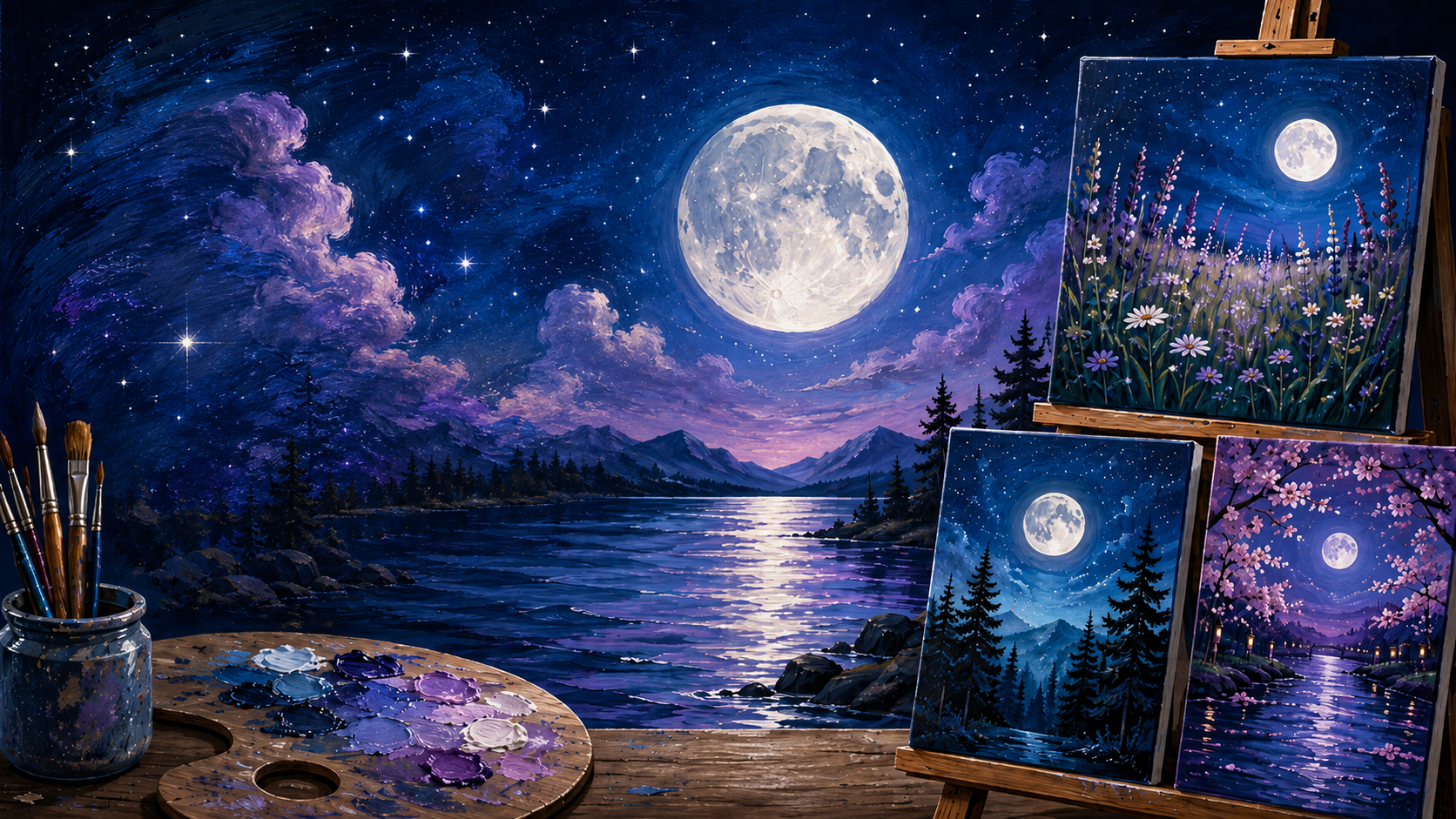
It's the same trees, mountains, or stretch of water that we see, beneath a sunny sky, looking cheerful and making us happy; But
wen they're under a glowing moon, they become quieter, dreamier, and a little more mysterious.
For centuries, artists have been fascinated by moonlight, and it’s easy to see why:
** The Night Leaves Something to the Imagination
During the day, we can clearly see colors, textures, and details. At night, much of that disappears.
In a painting, that can make a simple scene feel more interesting. Trees become silhouettes, distant landscapes fade into shadow, and our imagination fills in what we can’t quite see...
...That’s part of what makes paintings like Pinot’s Palette’s Moon Over the Pines feel so atmospheric. The bright moon draws your eye, while the darker surroundings add mystery...
One Bright Light Can Change Everything!
** Moonlight also creates beautiful contrast.
Against deep blues, purples, and blacks, even a small area of white or pale yellow can look incredibly bright. The moon quickly becomes the focal point of the painting.
Artists like J.M.W. Turner used this contrast dramatically in works such as 'Fishermen at Sea' (*see it here: https://www....turner/333142 ).
While softer paintings can use the same technique to create a peaceful feeling....
...Pinot’s Palette’s Moonlight Meadow is a great example of how moonlight can turn a simple landscape into something almost magical.
** It can be peaceful or even mysterious...
Moonlight can create very different moods.
A glowing moon over calm water can feel relaxing and romantic, while the same moon above bare trees or dark clouds can feel eerie...
... That’s especially fun during the fall season. Paintings like 'Moonlit Mischief' (9/9), and 'Enchanted Moonlight' (9/12) each use the moon in completely different ways.
*Even their names show how easily moonlight can shift from peaceful to magical to spooky.
** Nighttime Doesn’t Have to Be Black
Vincent van Gogh famously showed us that nighttime paintings don’t need to be dark or realistic.
In Van Gogh's 'Starry Night', the moon and stars glow against swirling blues and rich colors. Instead of simply painting what the night looked like, Van Gogh used the sky to express emotion.
(*You can also paint the same style of glowing moon in our version of Starry Night: 'Starry Night Chicago' (9/5)... and of course, in 'Enchanted Moonlight' (9/12), mentioned above.
That same idea of a non-black sky makes nighttime paintings so fun to create today.
A night sky can be blue, purple, turquoise, or even pink. Pinot’s Palette paintings like Moonlit Lavender and Lunar Pines show just how colorful moonlight can become.
** Reflections Make Moonlight Even Better
Moonlight becomes especially beautiful when water is involved.
The moon creates one bright focal point in the sky, while its reflection creates another across the water. This helps lead your eye through the painting and adds depth to the scene...
... That’s one reason paintings such as 'To The Moon and Back' (9/19) are so appealing. Moonlight, water, reflections, and flowering trees all work together to create a peaceful, dreamlike atmosphere.
*** Moon Paintings Make The Familiar Feel Magical
Perhaps the biggest reason we love moonlit paintings is that they make ordinary places feel different.
Trees become silhouettes. Water becomes a mirror. Clouds surround a glowing light. A landscape that might seem completely familiar during the day suddenly feels like another world...
... Like one of our newest paintings, 'Cotton Candy Waterfall' (9/26), which combines all of these elements.
And that’s the magic of moonlight in art; It allows a painting to feel peaceful and mysterious, familiar and imaginative, all at the same time.