

How Can Imperfect Art Be Some Of The Most Fun Art?
Your lines need to be straight, and your colors should always stay inside the lines. The finished piece should look like something you’d proudly hang in a gallery... or at least in your home, without hesitation.
But the truth is, that belief is the fastest way to suck the joy right out of creating.
In reality, imperfect art is where the fun lives, because perfection is pressure, and imperfection is freedom.
When you stop trying to make something flawless, something incredible actually happens: you relax; Your shoulders drop, you stop second-guessing every brushstroke or decision, and you start playing versus performing.
When art doesn’t have to be perfect, it becomes an experiment. A splash of paint here. A bold color choice there. A “mistake” that turns into your favorite part of the piece. Imperfection gives you permission to explore, and that’s where creativity thrives.
The Messy Parts Are Where The Best Memories Come From
Think about the moments you remember most vividly from creative experiences. It’s rarely the quiet, careful ones. It’s the laughs when paint drips where it shouldn’t. The surprise when two colors blend in an unexpected way. The moment someone says, “Well… that didn’t go as planned,” and everyone cracks up.
Imperfect art is shared art. It invites conversation, humor, and connection. It turns the act of creating into an experience, not just a result.
The “Mistakes” Are What Make Art Personal
Perfect art can feel distant... almost untouchable, but imperfect art feels human.
A crooked line, a slightly off-center subject, a brushstroke that clearly shows a hand behind it; These are the details that make a piece feel yours. They’re proof that a real person showed up, made choices, and put emotion into the work.
No two imperfect paintings are ever the same, and that’s kind of the magic.
"Letting Go" Is the Point
When you embrace imperfection, art stops being about comparison. You’re no longer asking, “Is this good enough?” You’re asking, “Did I enjoy making this?”
That shift changes everything.
Art becomes less about outcome and more about presence. About being in the moment. About doing something creative just because it feels good to do it.
Imperfect Art Is Brave Art
There’s something quietly courageous about creating without needing approval. About allowing yourself to make something that’s a little weird, a little messy, or completely unexpected.
Imperfect art says: I showed up anyway.
And honestly? That’s worth celebrating.
So the next time you pick up a brush, a pencil, or anything creative, give yourself permission to let it be imperfect. Smudge the paint. Try the risky color. Laugh when it goes sideways.
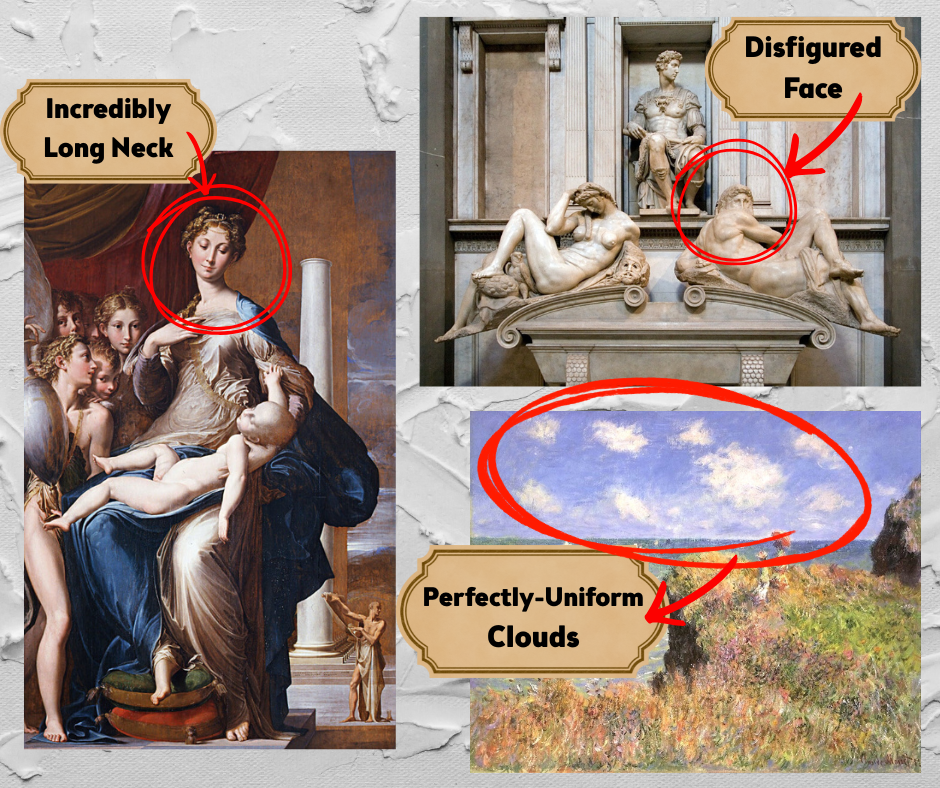
**Imperfect VERY FAMOUS Artwork, Shown Above:
Monet’s 'Cliff Walk at Pourville’ painting
In Claude Monet’s 1882 Cliff Walk at Pourville, the seemingly "imperfect" or stylized clouds, along with the, figures and landscape, are deliberate Impressionist techniques used to convey movement, wind, and light. Rather than realistic rendering, Monet used fast, broken brushstrokes and textured paint to create a fleeting, sensory experience of a, breezy, sunny day on the Normandy coast.
https://www....ster-artists/
Michelangelo’s ‘Night’ sculpture
Michelangelo’s ‘Night’ (c. 1526–1531) in the Medici Chapel features
intentional, non-classical "imperfections" that highlight her weary, unnatural form. Key attributes include an excessively muscular,, "manly" physique with a six-pack, a misshapen left breast, and strong, stiff legs, representing the physical ravages of time, childbirth, and lactation rather than ideal beauty.
The figure’s proportions are considered unnatural, but this may be due to its intended, uncomfortable reclining position on the Medici tomb.
https://www....ouspodcast/89
Parmigianino’s 'Madonna with the Long Neck’ painting
Parmigianino’s "Madonna with the Long Neck" (c. 1534–1540) is
considered "imperfect" because it was left unfinished at his death, embodying the intentionally distorted, asymmetrical, and non-rational style of Mannerism. It features, rather than a lack of skill, a deliberate manipulation of proportions, including a swan-like neck, tiny feet, and a strangely elongated, almost corpse-like Christ child.
The figures are not meant to be realistic. The Madonna is nearly twice the size of the angels, her neck is elongated for elegance, and her body forms an artificial "S-shape.”
https://www....parmigianino/
Share Come Paint With Us! | MORE Masterpieces With Imperfections